



Flowers
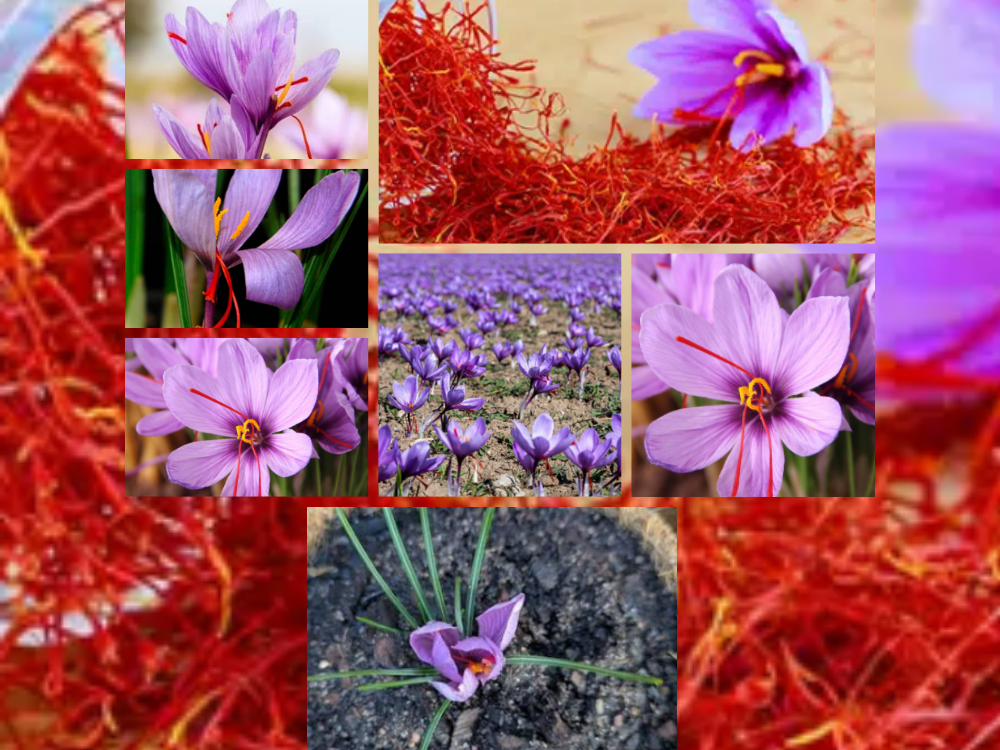
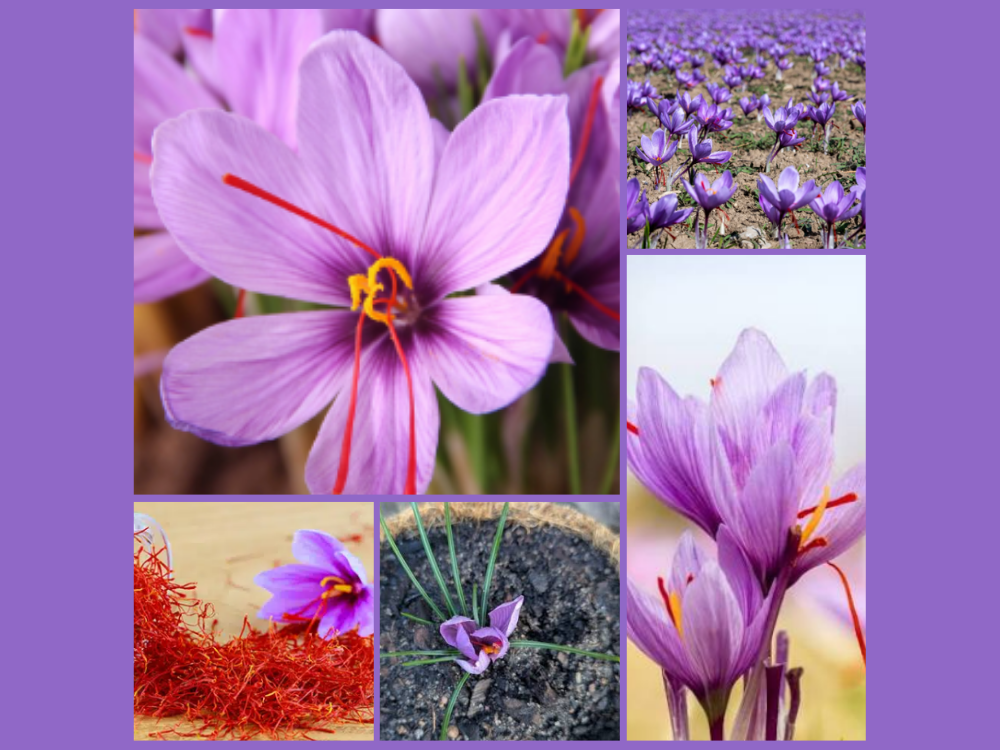
In early winter, two or three purple-colored flowers appear together. Sometimes, the flower tube is thin and has a single flower. Its petals are divided into six parts, from which three saffron threads emerge. This is the genuine saffron obtained from the female part of the crocus flower.
Saffron is produced from seeds, but it can also be propagated through roots. Fifty to sixty pounds of fresh saffron are obtained from one acre of land, but only eleven to twelve pounds remain after drying.
Its cultivation and preparation require considerable care and effort. Saffron flowers must be collected from the field early in the morning, before sunrise, while the flowers are still semi-open. In this condition, the petals are almost folded. When the sun rises, the flowers open and flatten, and high-quality saffron cannot be obtained from them.
Once the semi-open flowers are collected, they are placed on sieves and dried at a very low temperature. This allows them to dry gently and take the form of the saffron commonly available in the market.
Saffron is usually produced in Pampore, South Kashmir, at an altitude of approximately 4,300 feet. Apart from Kashmir, it is also produced in Italy, Spain, France, Iran, Portugal, Turkey, China, and other countries.
Chemical Components
Saffron contains three types of coloring components:
- Crocin
- Picrocrocin
- A glycoside
It also contains:
- Wax
- Protein
- Sugar
- Salivary components
Temperament
Hot in the second degree and dry in the first degree.
Actions
- Astringent
- Menstrual regulator
- Stimulant
- Liver tonic
- Heart tonic
- Brain tonic
- Body tonic
- Fast-acting
- Vision tonic
Uses
Due to its astringent properties, saffron is traditionally used internally and externally for menstrual bleeding. Its fibers are also traditionally used in the urethra for their astringent effect.
Because of its fast-acting properties, some people traditionally use saffron to dissolve liver and uterine tumors. It is also used as a poultice in the preparation of certain medicines.
Due to its liver-, heart-, and brain-tonic and stimulant properties, saffron is used in various medicinal preparations.
Because of its vision-tonic properties, it is traditionally applied to the eyes either alone or in combination with other medicines. Due to its tonic properties, it is also added to various tonic preparations.
Special Benefits
Saffron is traditionally regarded as an aphrodisiac, a fixative for many medicines, and a stimulant.
Dosage
One to two tablets.