



Introduction
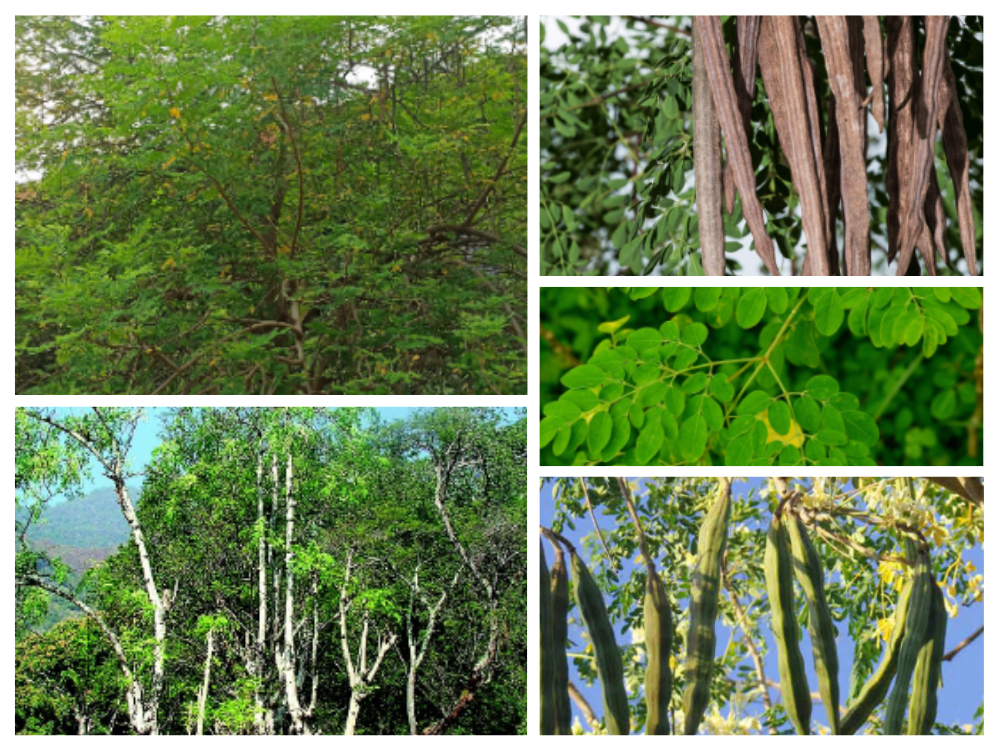
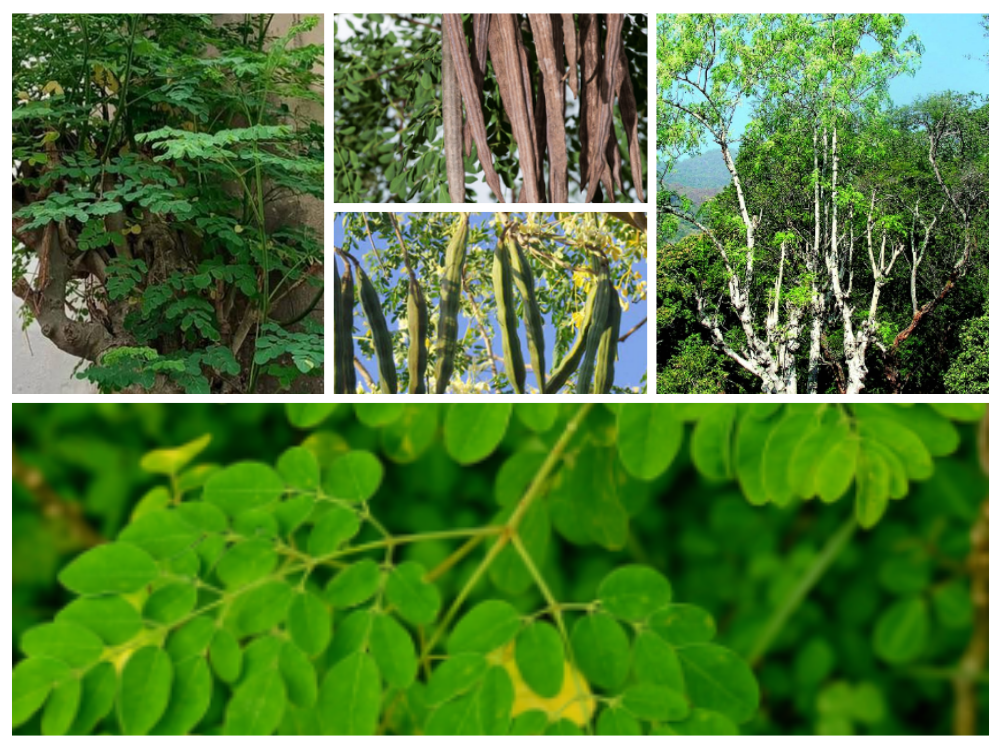
Moringa oleifera is a well-known tree that commonly grows in orchards, fields, and forests. It reaches a height of approximately 20–25 feet (6–7.6 meters), with a trunk circumference ranging from 1–5 feet (30 cm–1.5 meters). The bark is smooth and brown, and numerous branches spread outward from the trunk. The wood is very soft, delicate, and brittle. Each main branch produces numerous smaller branches.
Leaves
The leaves are arranged opposite each other and resemble those of the Siris (Albizia) tree.
Flowers
The flowers occur in white, yellow, and red varieties and are fragrant. The buds initially appear reddish, but when they open, the flowers are usually white. The white-flowered variety is the one most commonly used.
Pods and Seeds
The pods are long and slender, measuring approximately 9 inches to 1.5 feet (23–46 cm) in length. They are dark green and marked with longitudinal ridges.
As the pods mature, the seeds inside become larger. These seeds can germinate and produce new plants. Mature pods are grayish-brown on the outside and reddish on the inside.
The tree can also be propagated by planting a branch in suitable soil. The branch develops leaves and eventually grows into a new tree. A gum is also obtained from the tree.
Chemical Constituents
The bark contains an alkaline substance, resin, an acid, mucilage, and ash. The root contains a foul-smelling oil, while the shelled seeds contain approximately 35% oil.
The roots, sap, leaves, flowers, pods, and gum are traditionally utilized.
Temperament
Hot and dry (second degree).
Traditional Actions
Traditionally, Moringa oleifera is described as having the following properties:
- Remedy for cold-phlegmatic disorders
- Anthelmintic
- Carminative
- Digestive
- Phlegm-dissolving
- Resolvent
- Beneficial in dropsy
- Emollient
- Dispersing
- Sedative
- Nervine tonic
- Diuretic
Traditional Uses
Because of its traditionally described efficacy against cold-phlegmatic disorders, the flowers, leaves, pods, and gum are used traditionally for conditions such as paralysis, facial paralysis (Bell’s palsy), tremors, generalized pain, and rheumatism.
Intestinal Worms
The plant is traditionally regarded as an anthelmintic. Consuming a pickle prepared from its pods is described as beneficial for intestinal worms. The juice of the leaves is also traditionally administered to help expel worms.
Abdominal Bloating and Pain
Because of its carminative properties, the plant is traditionally used to relieve abdominal bloating, gas, and abdominal pain.
Nervous and Phlegmatic Disorders
Due to its traditionally described carminative, anti-phlegmatic, and nervine tonic properties, it is used traditionally in the management of epilepsy, paralysis, rheumatism, hysteria, and inflammation of the spleen.
Oral and Gum Complaints
The plant is traditionally regarded as having sedative properties. Gargling with a decoction of the bark is traditionally used for oral thrush (aphthous ulcers) and inflammation of the gums. It is also traditionally used for liver inflammation in children.
Traditional Moringa Pickle
A pickle prepared from the roots and pods is described as flavorful and traditionally used for phlegmatic and nervous disorders and various types of pain.
To prepare the pickle, the pods are seasoned with mustard seeds and salt, then dried in the sun for several days. They are subsequently steeped in vinegar and mustard oil.
Despite its sour taste, the traditional source states that this preparation does not harm the nerves.